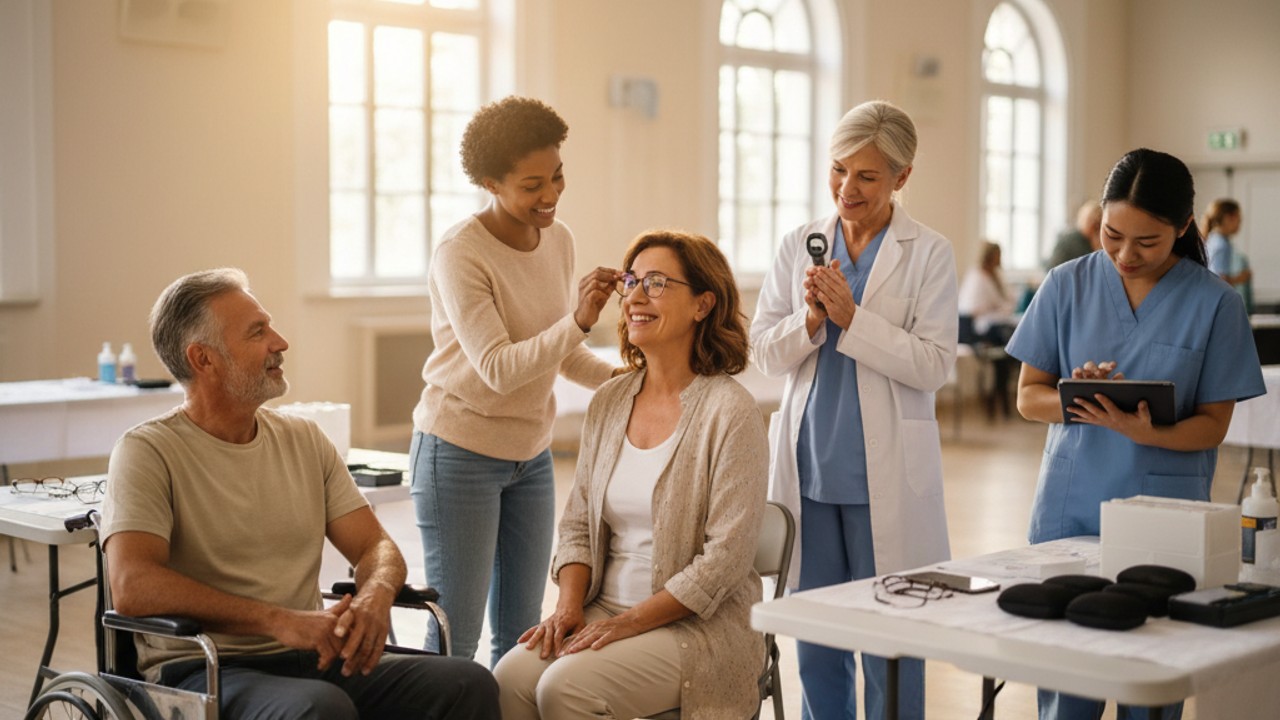
When nine-year-old Aisha walked into a makeshift clinic clutching an old photograph, she had stopped recognizing faces. A volunteer inspected her eyes, called a partner hospital, and within weeks Aisha saw her mother's face clearly for the first time in years. That single moment — joy, reunion, renewed possibility — shows how vision care and community action can rewrite a life.
At least 2.2 billion people worldwide have a vision impairment, and at least 1 billion of those cases could have been prevented or still need treatment, according to the World Health Organization. WHO fact sheet on blindness and visual impairment.
Vision loss often overlaps with disability and exclusion. More than 1 billion people live with some form of disability, and many face barriers to health care, education, employment, and digital access. These gaps are not inevitable — they are addressable with coordinated community service, youth engagement, and targeted resource access programs. WHO on disability and health.
Nonprofits are on the front lines. Sightsavers works to eliminate neglected tropical diseases that cause blindness and to strengthen local eye-care systems, while Orbis brings training and telemedicine through its Flying Eye Hospital to build local surgical capacity. These organizations blend public health, local partnerships, and volunteer networks to create scalable change. Sightsavers Orbis.
"At least 2.2 billion people have a vision impairment, of whom at least 1 billion could have been prevented or is yet to be addressed."
Why youth and community service matter
Youth are part of the solution: the United Nations estimates there are about 1.8 billion young people aged 10 to 24 worldwide. When young volunteers run awareness campaigns, staff vision-screening days, or teach digital skills to people with disabilities, they turn goodwill into lasting access. UN on youth.
How you can help today
- Partner or donate to proven organizations such as Sightsavers or Orbis to support surgeries, training, and mass-treatment campaigns.
- Organize a community vision screening or accessible service day through your local clinic or school; involve youth volunteers to expand reach.
- Advocate for inclusive policies that link vision care with disability services and digital access so people can learn, work, and participate fully.
- Share stories and data to build momentum: awareness fuels funding, policy change, and volunteer energy.
Hope is practical: scalable eye care, inclusive services, and youth-led community action already restore sight, open classrooms, and create pathways to work. Start small — host a screening, donate a few hours, or support a trusted nonprofit — and watch how many faces return to focus. Find out more and get involved with partners like Sightsavers and Orbis today.