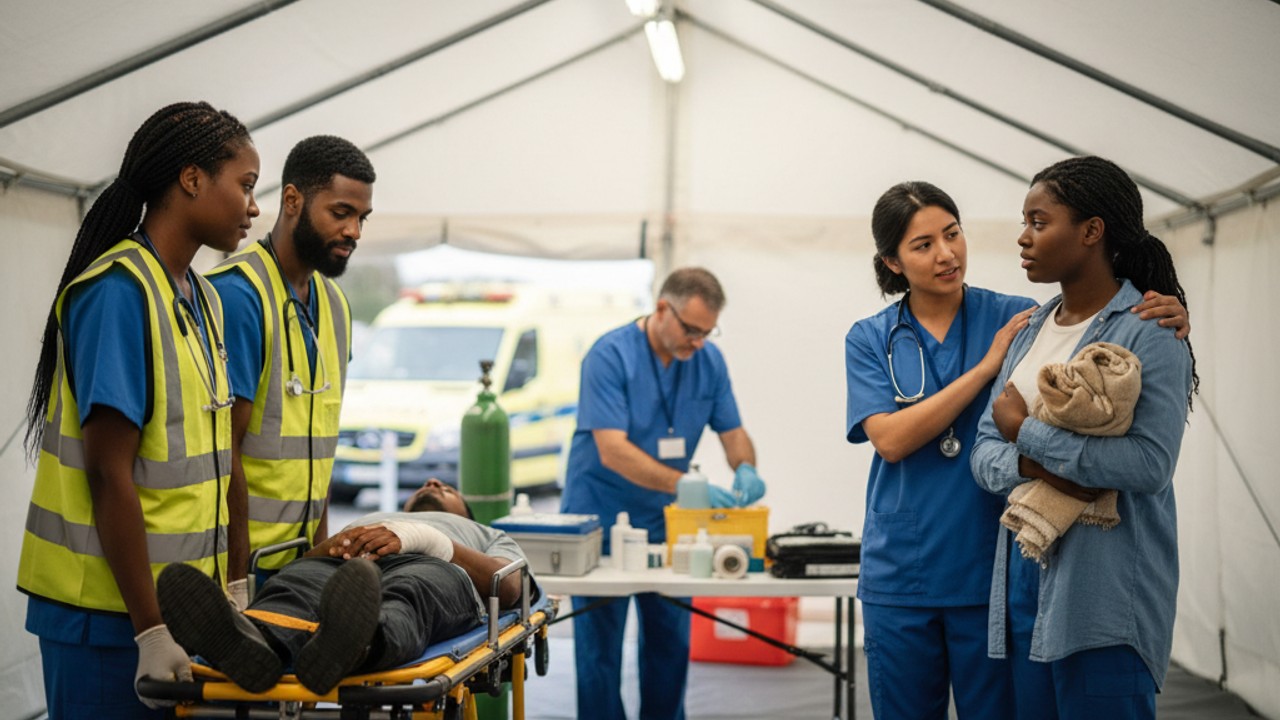
A young mother waits outside a makeshift clinic shifting from foot to foot as a medic lifts her feverish toddler into the fluorescent-lit tent. In crises from floods to conflict, that small tent is where seconds decide survival. Around the world, emergency care often stands between life and death.
Already stretched, increasingly needed
Humanitarian need is rising. The United Nations Office for the Coordination of Humanitarian Affairs warned in its Global Humanitarian Overview that hundreds of millions of people require aid each year as crises multiply and compound existing vulnerabilities. See the full overview Global Humanitarian Overview 2024. At the same time, more than 100 million people have been forced to flee their homes in recent years; UNHCR documents these historic displacement levels in its Global Trends 2023 report.
Those numbers are not abstract. They translate to flooded hospitals, ambulances turned away from damaged roads, and families separated from primary care. Emergency medical teams, field hospitals, and rapid-response units are the front line, turning chaos into a place where care can be delivered.
Who steps in, and how
Organizations like Médecins Sans Frontières (MSF) and the International Federation of Red Cross and Red Crescent Societies (IFRC) are consistently first on scene—setting up triage, performing surgeries, treating infections, and stabilizing newborns. The World Health Organization supports countries to strengthen emergency care systems to save lives in the critical hours after injury or illness; learn more on the WHO emergency care page Emergency Care | WHO.
"Rapid, organized emergency care reduces deaths and long-term disability after disasters and conflict."
That single sentence hides complex logistics: trained personnel, supply chains for oxygen and blood, functioning ambulances, and safe pathways to hospitals. When one link breaks, outcomes worsen.
How you can help right now
There is a clear path from awareness to action. You can move resources and attention where they matter most.
- Donate to trusted responders. Groups like MSF and the IFRC scale emergency medical services where needs are greatest; donations fund tents, medicines, and staff deployment (see MSF and IFRC).
- Advocate for funding. Urge policymakers and employers to support robust humanitarian budgets so emergency care systems are ready when disaster strikes.
- Volunteer or partner locally. Support local clinics, blood drives, and first-aid training programs to strengthen community response capacity.
In emergency care, hope is practical: a stocked ambulance, a trained nurse, a funded emergency operation center. These are things we can change today. If you can, give to reputable emergency responders, share verified information about ongoing crises, and ask leaders to prioritize emergency and health-system funding.
Every minute counts. Together, we can make them matter.